Showing posts with label 2020. Show all posts

Monday

December Book Group Choice

 Because of COVID and the health restrictions we were unable to have our annual Holiday cookie exchange and dinner. We set up a recipe exchange to share favorites but we all missed the joyfulness of face to face visiting and laughing. Our year wraps up with a Zoom discussion of our December book choice was interesting and engaging. This Alternative History novel by Ben H. Winters gave us a lot to talk about. 

Below is a brief part of the book review from NPR 2016: 

"Underground Airlines" imagines that the Civil War never happened. Rather, Lincoln was assassinated before he took office. And in an act of compromise, some states were allowed to maintain slavery. Those slave states, known as the Hard Four, consist in the present day of Louisiana, Mississippi, Alabama and the reunited Carolinas. They're demarcated from the rest of the U.S. by heavily patrolled borders.

The other states in the Union have agreed that any slave or person bound to labor, as they're called, must be returned to the corporate plantation from which they've escaped. That's where Victor, the anti-hero of this noir-ish novel, comes in. Victor is a bounty hunter working for the U.S. Marshals Service. He's adept at infiltrating abolitionist groups and retrieving runaways because he's black himself. Or rather, as Victor precisely tells us, he's moderate charcoal with brass highlights, which is one of the 172 varietals of African-American skin tone delineated in the U.S. Marshals Service field guide.

When the novel opens, Victor is sitting in a diner in Indianapolis with a Catholic priest who's suspected of running a rescue cell of what's called the Underground Airlines..." 

Friday

October/November Book Choice 2020

 This lush novel took two months to complete but was well worth the journey. Once Upon a River by Diane Setterfield provided us with a lengthy discussion and lots of wonderful moments. Here is a part of the Washington Post 2018 book review...

 " Diane Setterfield haunts familiar ground in “Once Upon a River,” an eerily mystic tale of a mute child who captivates the local townspeople after she’s seemingly brought back from the dead.

The author of “The Thirteenth Tale” and “Bellman & Black” begins this account on a winter solstice more than a hundred years ago. A near-drowned stranger arrives at a rural inn, grievously injured and carrying a young girl who, to all appearances, has already died. Despite the child’s corpse-like state,
however, the local nurse, Rita, discovers a pulse.

At different points the narrative emphasizes the powers of oral tradition, photography and performance, using stories that straddle fiction and fact to reveal essential truths to the speaker and the audience.

The river acts as both setting and character, a force in the everyday lives of its neighbors. Though Setterfield writes emotions with marvelous truth and subtlety, her most stunning prose is reserved for evocative descriptions of the natural world, creating an immersive experience made of light, texture, scent and sensation."

A perfect Tale to carry you into Winter!

Tuesday

August 2020 Book Choice

And here we are still in lockdown, slowly opening up with masks and social distancing. Our August selection is " The Little Old Lady who Broke all the Rules" by Catharina Igelman-Sundberg 


Here is part of the San Francisco book review:

Martha Andersson and her friends aren’t happy about the recent cost-cutting that’s been going on in Diamond House, their retirement home. Determined to continue living life to the fullest, the group hatches a plan to commit a crime and go to prison, where the living conditions are surely better. But being criminals is more complicated than they thought, and the situation quickly grows beyond anything they’d imagined.

Readers are sure to love Martha, Brains, Christina, Rake, and Anna-Greta, the delightful group of retirees that star in The Little Old Lady Who Broke All the Rules. Author Catharina Ingelman-Sundberg has written a truly fun and enjoyable novel here, with spunky main characters, a cunning plot, great supporting characters, and even a little bit of romance. The story is funny and easy to read; readers will want to make it all the way to the end to see if the oldies manage to pull off their perfect crime in the end and get the ultimate retirement they dream of.

June 2020 Book Choice

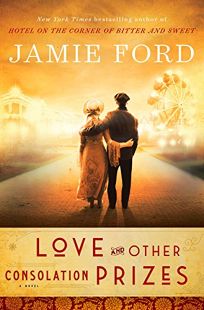
Love and Other Consolation PrizesAnd still in lockdown masks and social distancing to flatten the curve. The school year is coming to an end and book group is continuing with Zoom meetings. Nice to see everyone's face and connect.  Our May book choice was "Love and Other Consolation Prizes" by Jamie Ford. This was our 3rd book by Jamie Ford that we have selected-the Corner of Bitter and Sweet and The Songs of Willow Frost. 

Here is part of the review posted by Kirkus review Oct 2017:

Ernest has already lived a lifetime of surprises and indignities. After his starving Chinese mother secured her only son a spot on a freighter to America, Ernest, only 5 years old, had to learn swiftly how to navigate a world that denigrated him not only for being an orphan, but also, and perhaps worse, for being of mixed blood. Ernest never knew his white father, but his youth and mixed heritage enabled him to make friends with both the Chinese girls on the ship and the lone Japanese girl, Fahn. Once Ernest survived a month captive in the hold of the ship, not to mention a near drowning, he became a ward of the state in Seattle and eventually attracted a wealthy sponsor, who sent him to an exclusive boarding school, where he endured racism and discrimination, and then, when he has the temerity to tell her he would rather go to another school, she has him raffled off at the World's Fair. Surprisingly, life in the bordello is exciting, not least because there Ernest meets Madame Flora’s tomboyishly charming daughter, Maisie, and reunites with Fahn. Falling in love with both, however, can only lead to heartache, since life in a brothel exacts certain prices.

Alternating between Ernest’s past and present, Ford captures the thrill of first kisses and the shock of revealing long-hidden affairs.

A lively history of romance in the dens of iniquity, love despite vice.

May 2020 Book Choice

WHERE THE CRAWDADS SINGNo April choice this year. As we continue in Lockdown and keeping safe distances the Beehive is continuing with Zoom book group discussions. What has been fun is that now out of town and out of state members can join. This will be a feature we will continue with into the New post COVID world...The April book choice was the very popular "Where the Crawdads Sing" by Delia Owens.

Here is part of the book review from Krikus August 2018

“The Marsh Girl,” “swamp trash”—Catherine “Kya” Clark is a figure of mystery and prejudice in the remote North Carolina coastal community of Barkley Cove in the 1950s and '60s. Abandoned by a mother no longer able to endure her drunken husband’s beatings and then by her four siblings, Kya grows up in the careless, sometimes-savage company of her father, who eventually disappears, too. Alone, virtually or actually, from age 6, Kya learns both to be self-sufficient and to find solace and company in her fertile natural surroundings. Owens (Secrets of the Savanna, 2006, etc.), the accomplished co-author of several nonfiction books on wildlife, is at her best reflecting Kya’s fascination with the birds, insects, dappled light, and shifting tides of the marshes. The girl’s collections of shells and feathers, her communion with the gulls, her exploration of the wetlands are evoked in lyrical phrasing which only occasionally tips into excess. But as the child turns teenager and is befriended by local boy Tate Walker, who teaches her to read, the novel settles into a less magical, more predictable pattern. Interspersed with Kya’s coming-of-age is the 1969 murder investigation arising from the discovery of a man’s body in the marsh. The victim is Chase Andrews, “star quarterback and town hot shot,” who was once Kya’s lover. In the eyes of a pair of semicomic local police officers, Kya will eventually become the chief suspect and must stand trial.

March 2020 Book Choice


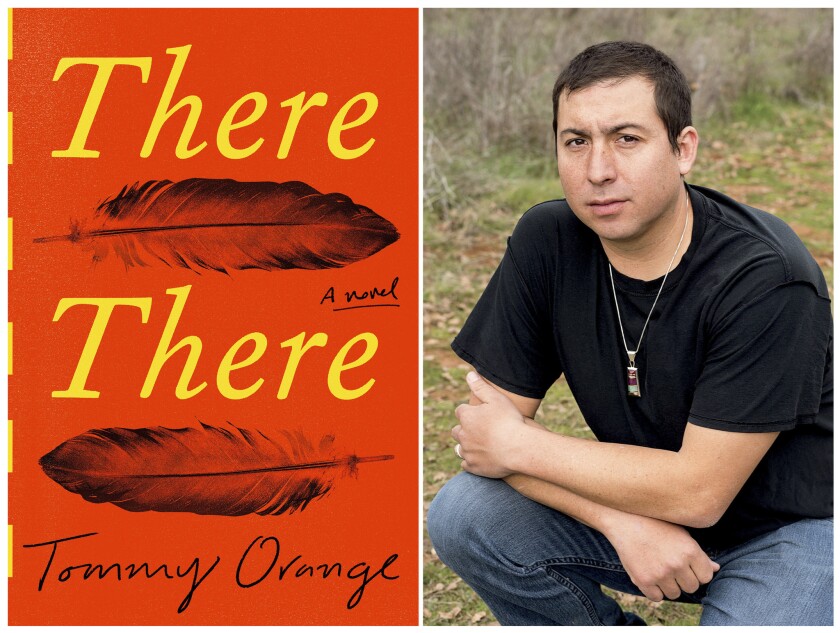
What's next for Tommy Orange? He talks about 'There There' sequel ...

March was a month of change and tension. As COVID-19 became more widespread and a national shutdown unfolded we all try to figure out how to adjust our lives. This was our first Zoom Book Club meeting. Our March book of Choice was There, There by Tommy Orange.

Here is part of the book review by NPR June 2018

Here's the thing about There There, the debut novel by Native American author Tommy Orange
Even if the rest of its story were just so-so — and it's much more than that — the novel's prologue would make this book worth reading.


In that 10-page prologue, Orange wittily and witheringly riffs on some 500 years of native people's history, a history of genocide and dislocation presented mostly through the image of heads. He begins with a description of the "Indian Head test pattern," a graphic that closed out America's television programming every night during the age of black-and-white TV. He then catapults backwards to 1621 and the first Thanksgiving, then bebops through a litany of Indian massacres in American history.

There There is distinguished not only by Orange's crackling style, but by its unusual subject. This is a novel about urban Indians, about native peoples who know, as he says, "the sound of the freeway better than [they] do rivers ... the smell of gas and freshly wet concrete and burned rubber better than [they] do the smell of cedar or sage..."

Orange's story takes place in Oakland, Calif., and his title comes from the famous pronouncement about rootlessness that Gertrude Stein made when, as an adult, she revisited Oakland, her childhood home. "There is no there there," Stein said.


Orange knows the feeling and the terrain: He also grew up in Oakland and is enrolled in the Cheyenne and Arapaho tribes of Oklahoma. But in There There, Orange wanted to do something more than fictionalize his own experience. Instead, his novel is composed of the stories of a bunch of Native and mixed-race characters, all of them eventually converging in a climactic scene at a big powwow in the Oakland Coliseum.

In a satiric aside, Orange says that one thing that unites the diverse powwow participants is the type of bumper stickers they've slapped on their cars: They all sport Indian pride messages like "My Other Vehicle Is a War Pony" and "Fighting Terrorism Since 1492."


Like those bumper stickers, There There is pithy and pointed. With a literary authority rare in a debut novel, it places Native American voices front and center before readers'

Wednesday

February 2020 Book Choice


Moving into the year with a dynamic and moving selection by the one and and only Toni Morrison: Song of Solomon.

Kirkus Review
1977
Song of SolomonAnd the scribbled no-name "Macon Dead," given to a newly freed black man by a drunken Union Army officer, has stained out a family's real name for three generations, and then we meet the third "Macon Dead," called "Milkman." Raised among the sour hatreds of the richest black family in a Michigan town, Milkman learns not to love or make commitments, learns to turn away from his father's hard, tight greed, his mother's unloved passivity, his sisters' sterile virginity. He stands apart from his outcast aunt Pilate (a figure reminiscent of Sula, living beyond all reason), a "raggedy bootlegger" who keeps her name in a box threaded to one ear. And he stands above the wild untidy adoration of his cousin Hagar, above the atrocities against blacks in the 1950s, even while his friend organizes a black execution squad. However, when Milkman's father opens the door to a family past of murder and flight, Milkman—in order to steal what he believes is gold—begins the cleansing Odyssean journey. His wanderings will take him through a wilderness of rich and wonderful landscapes murmuring with old tales, those real names becoming closer and more familiar. He beholds eerie appearances (an ancient Circe ringed with fight-eyed dogs)—and hears the electric singing of children, which holds within it the pulse of truth. Like other black Americans, Milkman's retrieval of identity from obliteration helps him to shake off the "Dead" no-name state of his forebears. And, like all people, his examination of the past gives him a perspective that liberates the capacity for love. Morrison's narration, accomplished with such patient delicacy, is both darkly tense and exuberant; fantastic events and symbolic embellishments simply extend and deepen the validity and grace of speech and character.


When you know your name, you should hang on to it, for unless it is noted down and remembered, it will die when you die."

Molly hosted the dinner at her lovely home filled with friendship and deep conversation. 


January Book Choice 2020


Dear Mrs. Bird by AJ Pearce started our new season of ready.
Here is the Kirkus Review July 2018:

Review: Dear Mrs. Bird | Reading LadiesInnocence and perky optimism are tempered by less sunny feelings over the course of British novelist Pearce’s debut, which opens with a relatively upbeat evocation of World War II London as experienced by 22-year-old legal secretary Emmy. Fond of larky contemporary expressions and capital letters—“I gave what I hoped was a plucky Everything Is Absolutely Tip Top smile”—Emmy yearns to be a Lady War Correspondent and finds a new job at Woman’s Friend magazine. But her duties turn out to include destroying problem-page letters on unacceptable topics (“Premarital relations, Extramarital relations, Physical relations,” etc.) on behalf of her boss, battle-axe agony aunt Mrs. Henrietta Bird. Warmhearted Emmy can't bear to leave these needy women's letters unanswered and begins replying to them in secret, forging Mrs. Bird’s signature. Matters turn more serious after Emmy has an argument with her best friend Bunty’s fiance, William, over his risky work as a fireman.  Vividly evocative of wartime life, with its descriptions of bombed streets, frantic fire stations, and the desperate gaiety and fortitude of ordinary souls enduring nightly terror, Pearce’s novel lays a light, charming surface over a graver underbelly. With its focus on the challenges and expectations placed on those left behind, it also asks: Who is supporting the women in a world turned upside down by war?

 “a jaunty, heartbreaking winner” (People)—for fans of The Guernsey Literary and Potato Peel Pie Society and Lilac Girls.

Jane hosted the dinner at her bungalow the conversation was lively and the food yummy.