Sunday

May Book Club Brunch on a June day

The May book club meeting was held on the first Sunday of June at Jane's colorful family cottage, and in attendance was honorary Southern Belle Mary Helen Kennedy.


Yummy food and spirited conversation flowed freely as the guests dinned in the most informal garden setting. The Southern Gothic novel takes place in Florida and Beth brought gator jerky and Judy brought a gator head and some Mississippi Mud to sip (if you dare).

May Book Club Choice

Our May Book choice was "Swamplandia!" by Karen Russell. The meeting will be an early June brunch.
Here is what the NY Times reviewer  Emma Donoghue had to say about this book-

"In 2006, Zoetrope published a story by a 24-year-old writer, Karen Russell. That story, “Ava Wrestles the Alligator,” featured a lusciously strange setting (an alligator theme park in the Everglades) and a tough young heroine with a dead mother and an absent father, as well as a weird problem: how to save her resented-yet-beloved older sister from eloping with a ghost. A few months later, Russell’s first story collection, “St. Lucy’s Home for Girls Raised by Wolves,” with “Ava Wrestles the Alligator” leading a crazy procession of nine other Florida swampland stories, won her wide acclaim, and last year she was chosen one of The New Yorker’s “20 Under 40” top fiction writers.
Now her fans can sink their teeth into her first novel, “Swamplandia!,” a sort of expansion of and sequel to that alligator story. Vividly worded, exuberant in characterization, the novel is a wild ride: Russell has style in spades.

The setting and the sisters (Ava and Osceola, a k a Ossie) are the same, but they now benefit from a full back story. It’s easier to care about the pleasures and miseries of life in a failing gator park when we know how the father (the self-proclaimed Chief Bigtree) and his family ended up there, and are led to understand what goes into the routine of putting on death-defying shows every day. If Russell’s style is a North American take on magical realism, then her commitment to life’s nitty-gritties anchors the magic; we are more inclined to suspend disbelief at the moments that verge on the paranormal because she has turned “Swamplandia!” into a credible world.
Ava is a highly appealing narrator who has many talents beyond swimming with gators or taping their jaws shut. If protagonists (especially of first novels) typically bewail the mundanity of their small towns, the exotic is normal to Ava. Her first-person narration is not a transcription of a 13-year-old voice, but an evocation, in adult language, of a barely adolescent mind-set. This allows for a dazzling level of linguistic invention. Here Russell as Ava describes the dozen houses on pilings that make up the abandoned outpost of Stiltsville: “dawn light screaming through the doorways that hung on their hinges, the broken windows that birds could fly through, the plank lace, the cheesed metals.” "

Interesting to note this reviewer is the author of a previous Beehive book-Room

April 2012 Book Club Meeting

Betsy hosted the April meeting in her Sunset magazine like back garden.

We celebrated spring, the great book and Beth's birthday with a Beehive cake.

It was a most pleasant spring evening made even more lovely with wonderful friends, great discussions and many yummy foods and treats.

Thursday

http://www.bookbrowse.com/

Fun site for book lovers...browse

April Book Club Choice

April book choice: Daughter of Fortune by  Isabel Allende
Here is the book jacket summary:
Orphaned at birth, Eliza Sommers is raised in the British colony of Valparaíso, Chile, by the well-intentioned Victorian spinster Miss Rose and her more rigid brother Jeremy. Just as she meets and falls in love with the wildly inappropriate Joaquín Andieta, a lowly clerk who works for Jeremy, gold is discovered in the hills of northern California. By 1849, Chileans of every stripe have fallen prey to feverish dreams of wealth. Joaquín takes off for San Francisco to seek his fortune, and Eliza, pregnant with his child, decides to follow him.
So begins Isabel Allende's enchanting new novel, Daughter of Fortune, her most ambitious work of fiction yet. As we follow her spirited heroine on a perilous journey north in the hold of a ship to the rough-and-tumble world of San Francisco and northern California, we enter a world whose newly arrived inhabitants are driven mad by gold fever. A society of single men and prostitutes among whom Eliza moves--with the help of her good friend and savior, the Chinese doctor Tao Chien--California opens the door to a new life of freedom and independence for the young Chilean. Her search for the elusive Joaquín gradually turns into another kind of journey that transforms her over time, and what began as a search for love ends up as the conquest of personal freedom. By the time she finally hears news of him, Eliza must decide who her true love really is.
Daughter of Fortune is a sweeping portrait of an era, a story rich in character, history, violence, and compassion. In Eliza, Allende has created one of her most appealing heroines, an adventurous, independent-minded, and highly unconventional young woman who has the courage to reinvent herself and to create her own destiny in a new country. A marvel of storytelling, Daughter of Fortune confirms once again Isabel Allende's extraordinary gift for fiction and her place as one of the world's leading writers.

Translated by Margaret Sayers Peden

From the Boston Globe:
"An intricate novel by a fine storyteller....Once the reader submits to her wizardry, a florid, detailed universe of hopes and lust, of class struggle and quarreling individual identities, unfolds."


Wednesday

March Book Club Meeting

Our March get together was held at Molly's lovely home. The book Room had limited food references but many chose to go with the comfort aspect with such foods as macaroni and cheese . Some of our most interesting questions and discussion involving childhood, parenting and survival were inspired by this book.

March Book Club Choice

This month we read the book Room by Emma Donoghue

Here is what the Observer writer Nicola Barr had to say about this book (July 2010)
"Room is in many ways what its publisher claims it to be: a novel like no other. The first half takes place entirely within the 12-foot-square room in which a young woman has spent her last seven years since being abducted aged 19. Raped repeatedly, she now has a five-year-old boy, Jack, and it is with his voice that Donoghue tells their story.


And what a voice it is. "Ma" has clearly spent his five years devoting every scrap of mental energy to teaching, nurturing and entertaining her boy, preserving her own sanity in the process. To read this book is to stumble on a completely private world. Every family unit has its own language of codes and in-jokes, and Donoghue captures this exquisitely. Ma has created characters out of all aspects of their room – Wardrobe, Rug, Plant, Meltedy Spoon. They have a TV and Jack loves Dora the Explorer, but Ma limits the time they are allowed to watch it for fear of turning their brains to mush. They do "phys ed" every morning, keep to strict mealtimes, make up poems, sing Lady Gaga and Kylie, and most importantly, Ma has a seemingly endless supply of stories – from the Berlin Wall and Princess Di ("Should have worn her seatbelt," says Jack) to fairytales like Hansel and Gretel to hybrids in which Jack becomes Prince Jackerjack, Gullijack in Lilliput: his mother's own fairytale hero. And really, what is a story of a kidnapped girl locked in a shed with her long-haired innocently precocious boy if not the realisation of the most macabre fairytale?

For me, the rhythm of Ma and Jack's speech bears traces of the author's native Irish brogue, though the second half reveals the setting to be America (Donoghue now lives in Canada). But this only adds to the strange, dislocating appeal of Room. In the hands of this audacious novelist, Jack's tale is more than a victim-and-survivor story: it works as a study of child development, shows the power of language and storytelling, and is a kind of sustained poem in praise of motherhood and parental love."

February 2012 Book Club meeting

 Kitty hosted our February gathering in her artistically inviting East Sac home. I am somewhat relieved to report that there was no Turkey Neck soup in the eclectic mix of sophisticated foods and bevy of beverages. Good conversation and laughter as we shared the goings on via the Internet with Beth who was unable to attend.

February Bookclub Choice


Our February bookclub choice is "I feel bad about my neck...and other thoughts on being a woman" by Nora Ephorn.

"Nora Ephron has mastered the art of seeming likeable - a rarer facility than one might think. In tone and touch, her essay collection I Feel Bad About My Neck makes a useful bible for those of us who foster the less useful knack for seeming irritating.Sweetly packaged in an undersized format, this admittedly slight collection - much of which has been published previously in magazines - imparts a few nuggets of wisdom that you can take to the bank: "Never marry a man you wouldn't want to be divorced from," and, even more importantly, "Don't buy anything 100% wool even if it seems to be very soft and not particularly itchy when you try it on in the store."

the Guardian April 2007

January 2012, first book meeting of the New Year

 Annette hosted our first Book Club meeting of 2012 in her elegant and inviting home. We enjoyed a lively evening of discussion and book inspired Middle Eastern and Old world foods, with a few modern twists.


Monday

Judging a book by their cover with artist, Mike Stilkey

alamodeus: Judging books by their cover ...: Growing up, Los Angeles native Mike Stilkey must have been a librarian's worst nightmare. But today, his mix of ink, colored pencil, paint...

Thursday

January 2012 Book Choice

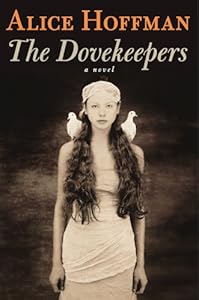
The Dovekeepers by Alice Hoffman

The DovekeepersUSA Today book review October 2011 

Alice Hoffman weaves fiction and fact in The Dovekeepers, a thrilling, passionate saga of four women who come together to tend the doves in Masada. Using the only written account of the siege, Hoffman salts her fictional tale with archaeological artifacts found at Masada — a swatch of tartan cloth; inscribed pottery shards; a pair of sandals — to imagine how the seven might have survived. And how the end came for others.

Hoffman's novels find magic in the mundane, and the mystical swirls through The Dovekeepers. Sudden rain, a circle of red hawks and a lion in the desert all hold hidden meaning. The doves represent sustenance and sacrifice; their bleached bones are studied for signs of the future.


Fans of Hoffman's more modern women will find the dovekeepers surprisingly rebellious for their day. They take married lovers and flout religious law to protect the ones they love. Did I mention passion? Once smitten, their men cannot keep away.

Hoffman spent five years researching Masada, and early on, her desire to share that knowledge clutters the plot. But soon the book pulses toward its stunning climax. Hoffman's fiction is always compelling, but the history within The Dovekeepers makes this novel haunting.

Wow...this should be a great book group meeting.

Monday

December holiday cookie exchange

 Betsy once again hosted our holiday cookie exchange and book group at her festive and elegant home. We all enjoyed the soup, salad, beverages and a plethora of cookies and treats. Much book talk, what we read this year, likes and dislike and what we'd like to read next year. It was a wonderful way to welcome the holiday season and say good-bye to yet another year.

November/December book choice

We are ending the year with a short story by Truman Capote " A Christmas Memory" .

October bookgroup meeting

  We met the first Friday of November for our October book. Deborah hosted at her lovely midtown home.We really enjoyed the language of this book and the tea sandwiches and other treats were also a delight.

October 2011 Book choice

The Picture of Dorian Gray by Oscar Wilde is our October choice

Online book review:
The Picture of Dorian Gray is Oscar Wilde's only known novel. The work first appeared in Lippincott's Monthly Magazine in 1890, and it was revised and published as a novel the following year. The work was considered scandalous and immoral when it first appeared, but it was really a way for Wilde to write about his philosophy of art.

quotes from the book:

•"The ugly and the stupid have the best of it in this world. They can sit at their ease and gape at the play."


- Oscar Wilde, The Picture of Dorian Gray Ch. 1

•"You are a wonderful creation. You know more than you think you know, just as you know less than you want to know."


- Oscar Wilde, The Picture of Dorian Gray Ch. 2


•"Humanity takes itself too seriously. It is the world's original sin. If the cave-man had known how to laugh, History would have been different."


- Oscar Wilde, The Picture of Dorian Gray Ch. 3


•"There were moments when he looked on evil simply as a mode through which he could realise his conception of the beautiful."


- Oscar Wilde, The Picture of Dorian Gray Ch. 11


Saturday

September bookgroup meeting

Rory/Beth hosted the September bookgroup and Suzi was the "brains" behind the choice. Yummy thought provoking dishes and of course chocolate and pink brain jello...all food for thought.


September book choice 2011

Our September book choice was suggested by Suzi Bryd. The Female Brain by Louann Brizendine, M.D.

Summer bookgroup meeting

Our summer July/August book group meeting was hosted at the Hastings house and the book "boss" was Miss Molly.
Palace Walk was an epic family saga with lots of characters and dramatic twists and turns.

The event was well attended and there was a lovely selection of Egyptian inspired foods as well as a little belly dancing.


Monday

100 Best opening lines from a book

http://www.stylist.co.uk/life/the-best-100-opening-lines-from-books
Check out this site for the 100 best opening lines in a book
for example our October book choice is part of this collection:

"The Picture of Dorian Gray"

"The studio was filled with the rich odour of roses, and when the light summer wind stirred amidst the trees of the garden, there came through the open door the heavy scent of the lilac, or the more delicate perfume of the pink-flowering thorn."

Summer Reading

Our July August book is Palace Walk by Nabuib Mahfouz, and our first Nobel Prize winning selection.

Reviewed by Daniel Pipes

Washington Times
February 12, 1990

Palace Walk is the greatest novel of Naguib Mahfouz, the Noble Prize winner for literature in 1988; and it and the two other parts that round out the Cairo Trilogy may well be the masterpiece of Arabic literature in the twentieth century.


In Palace Walk (the name refers to a major street in the old part of Cairo), Mahfouz details the process of modernization in Egypt from the ground up through the story of a single Cairene family, the 'Abd al-Jawads, in the course of a single year, 1919.

June Bookgroup Meeting

Molly was the wonderful hostess for our June book club meeting. We had a grand time, there was book talk, yummy food, drinks and a good-luck red velvet/mocha cake for Beth...not good-bye. All in all a wonderful way to start the summer.

(from Author's website)
The Zookeeper's Wife is about one of the most successful hideouts of World War II. It's a tale of people, animals, transcendence, and subversive acts of compassion.


ORION MAGAZINE ANNOUNCES THE WINNER

OF THE 2008 ORION BOOK AWARD

Diane Ackerman's The Zookeeper's Wife: A War Story (W. W. Norton) has been selected to receive the 2008 Orion Book Award, which is conferred annually to a book that deepens our connection to the natural world, presents new ideas about our relationship with nature, and achieves excellence in writing.

"The Zookeeper's Wife is a groundbreaking work of nonfiction," said selection committee member Mark Kurlansky, "in which the human relationship to nature is explored in an absolutely original way through looking at the Holocaust." Kathleen Dean Moore, the committee's chairperson, said: "A few years ago, 'nature' writers were asking themselves, How can a book be at the same time a work of art, an act of conscientious objection to the destruction of the world, and an affirmation of hope and human decency? The Zookeeper's Wife answers this question."


There was a lively discussion about the book as well as other life stuff...We also wished Beth luck as she made the move up north to the Seattle Starbucks HQ. Rory had this very special "Coffee Cake" made in her honor. Yummy!